Remembering the Ones Who are Gone
Grief slips in through familiar rooms, old smells, and the sound of a song we forgot we loved.

Margaret Ann Ackerman
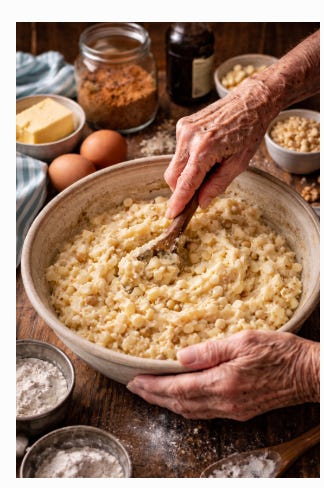
My mother loved visitors, especially if it was one of her eight kids, all grown up now. She could usually be found manning the kitchen, “command central,” I’d dubbed it, like a 24-hour Aid station. A large glass jar full of shiny, braided cookies stood on the counter; the Corelle tea kettle, filled with water, waited on the stove, ready to whistle.
When I was a kid, I’d perch in a chair by the window facing the driveway and bask in her company. One day, while she chatted on the phone, dragging the long cord behind her as she moved about, I sat daydreaming about Ricky Ricardo. Ricky was my first crush, and I wanted to be Lucy.
I took a pencil and carved “LUCY” into the new, freshly shellacked windowsill, then drew a heart around it.
“That’s not even your name!” was all Ma said. From then on, my hands were kept busy, and I became a sort of sous chef (okay, a scullery maid), running to the basement to fetch potatoes from the 50-pound bag or grabbing flour for the never-ending cookies she was baking.
Years later, that perch became my porthole. I’d peek in as I passed by for a sneak preview of the kitchen theatre. A few days before Christmas, on a surprise visit, I looked in and saw her standing at the scarred old maple table, a mixing bowl to her right, a cookie sheet to her left, and a small patch of flour in the center.
She pulled off a piece of dough, rolled it in the palm of her hand, shaped it into an S, and placed it on the cookie sheet.
“Yum,” I thought. White S’s, my favorite.
I waited for her to spot me, but she didn’t. She was lost in her own thoughts, her cheeks glistening with tears. Stepping into the kitchen, I heard Tony Bennett crooning, I’ll Be Home for Christmas from the old black AM radio on the counter.
“Oh, Gootsa, it’s you,” she said with a faint smile, eyes still moist.
“Why are you crying?”
“It’s the music. It makes me sad.”
“Why?” I said, sounding like a petulant five-year-old.
“It reminds me of the ones who are gone.”
“So why do you listen to it?”
“Because it reminds me of the ones who are gone.” She shrugged.
I didn’t get it. Why didn’t she listen to something else? But before I could ask, her face softened and she said, “Come and help me make the cookies.”
Standing side by side, we rolled cookies. Mine kept breaking, and the flour stuck to my fingers. “Just a smidge of flour when you roll them,” she said, her gnarled hands guiding mine.
Whatever a smidge is. Ma measured ingredients in body parts: a fistful, thumb-sized; I never knew whose fist or thumb she meant. I added about a smidge and a half; the dough dried and cracked.
Ma rolled six cookies while I fussed with one.
“Why can’t I just make circles?” I asked.
“Because this is how we do it.”
Traditions are meant to be honored.
Twenty- one years after Ma is gone, I stand at my own counter, looking down at my gnarled fingers, so like Ma’s, shaping the dough into something barely recognizable as an S. I roll it in a little flour; it sticks to my fingers; white clouds sprinkling my sweatshirt and dotting my dog’s head.
I think of my mother’s kitchen; the noise, the ingredients scattered across the table, the ringing phone. I long to stop by and peek through that kitchen window. Just one more time.
“Alexa, play Tony Bennett,” I shout.
His voice floated through the speaker: “I’ll Be Home for Christmas.”
Tears filled my eyes. I let them fall.
Why am I crying? I asked myself.
I cry because I didn’t cry with Ma.
I cry because I miss the ones who are gone.
And I finally get it.
She never turned the music off because grief is nothing to fear.
It’s how we keep the ones we love with us.
Beautiful, Peg!
Beautiful!♥️